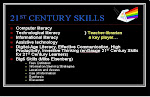
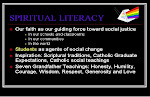
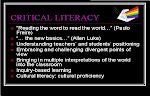
One of the predominant themes in my blog has been learning in the 21st century. Recently, I was involved in a meeting about how we can truly begin to prepare staff and students in our system for what this means in terms of access to technology, in particular, web-based technologies. When I watched this clip on YouTube, I thought that it speaks volumes about what is really at the heart of the conversation, and that's our kids. Have a look...
Showing posts with label education. Show all posts
Showing posts with label education. Show all posts
18 April 2010

08 January 2010
Student Directed Learning Notes
This posting excites me for two reasons:
1. I finally learned how to upload a document that wasn't a power point using Slideshare, and
2. It's some of the work I've been doing around student-directed learning. I really can't wait to get back into the classroom...
I know first-hand what an amazing learning opportunity this can be for students. In my final year at York University, because of my GPA, I was permitted to design my own History course. I had to seek out a professor who would meet with me on a weekly basis to discuss what I had been reading and writing. The readings that were selected by me had to support my central inquiry question. In my case my question was, "Did the death of Pierre Elliotte Trudeau create an identity crisis for Canadians?" I also had to come up with a working hypothesis, which I fleshed out with my weekly writing. I surveyed people. I researched in the National and Provincial Archives - online and in person. It was a really rich learning experience. My culminating task was a huge, 50-page paper. I had to present it to my professor before he graded it. I was truly proud of myself when I was done. There wasn't a course like it being offered and it was exciting to me because identity politics is a topic that I was, and continue to be passionate about. By the time one reached the final year of a 5 year Honours program along with a three years in the Concurrent Program at the Faculty of Education, one is generally tired and looking forward to the end. This one course really revitalized me as a student and had a significant impact on me as an educator.
I recently made the decision to return to the classroom this September. I am really hoping that I'll get to pilot this back at me school. If not, this is certainly going to be worked in, somehow, to a course I'll teach because I want to students to be excited about coming to school and I want them to know that they can contribute to a body of knowledge that they are passionate about.
1. I finally learned how to upload a document that wasn't a power point using Slideshare, and
2. It's some of the work I've been doing around student-directed learning. I really can't wait to get back into the classroom...
Student Directed Learning Notes
View more documents from ChrissyYCDSB.
I know first-hand what an amazing learning opportunity this can be for students. In my final year at York University, because of my GPA, I was permitted to design my own History course. I had to seek out a professor who would meet with me on a weekly basis to discuss what I had been reading and writing. The readings that were selected by me had to support my central inquiry question. In my case my question was, "Did the death of Pierre Elliotte Trudeau create an identity crisis for Canadians?" I also had to come up with a working hypothesis, which I fleshed out with my weekly writing. I surveyed people. I researched in the National and Provincial Archives - online and in person. It was a really rich learning experience. My culminating task was a huge, 50-page paper. I had to present it to my professor before he graded it. I was truly proud of myself when I was done. There wasn't a course like it being offered and it was exciting to me because identity politics is a topic that I was, and continue to be passionate about. By the time one reached the final year of a 5 year Honours program along with a three years in the Concurrent Program at the Faculty of Education, one is generally tired and looking forward to the end. This one course really revitalized me as a student and had a significant impact on me as an educator.
I recently made the decision to return to the classroom this September. I am really hoping that I'll get to pilot this back at me school. If not, this is certainly going to be worked in, somehow, to a course I'll teach because I want to students to be excited about coming to school and I want them to know that they can contribute to a body of knowledge that they are passionate about.
10 December 2009
Some Food For Thought...
In May of 2008, Sony BMG featured this video at a conference. It fits in beautifully with the major themes around 21st century learning. We included this as part of the materials for the September PA Day, which focused on differentiating instruction for the 21st century learner.
27 October 2009
Full-Day Kindergarten Kinda Makes Sense...
I'm not entirely sold on Ontario's premier. I am, however, liking his idea to make kindergarten a full day more and more. He was recently quote as having said, "In a highly competitive, global knowledge-based economy it's absolutely essential that we invest in the younger generation to ensure that we build a powerful workforce that can compete and win against the best anywhere on this planet." I think he makes a good point. Research also shows that kids who attend full-day programs before grade one have better-developed social and academic (especially literacy and vocabulary) skills. In Ontario, kids get access to these kinds of programs if their parents can afford it. Full day kindergarten will level the playing field in terms of what young children have access to in their formative years.
I have to admit, this is tres gutsy, given the current economic climate. Anyone who is willing to present taxpayers with an annual bill for $1.5 billion has got my respect.

I have to admit, this is tres gutsy, given the current economic climate. Anyone who is willing to present taxpayers with an annual bill for $1.5 billion has got my respect.
26 October 2009
iPods in Education ... iLike!

Skeptics of the world, hear me out... I know what you're all thinking. We don't need to give our kids yet another excuse not to pay attention in class. I know that this idea will take a little getting used to be it actually makes so much sense.
When I was at When Faith Meets Pedagogy on Friday, I attended a session called iTouch, iLearn. It was hosted by Rob Policicchio of Apple Canada. The focus of the presentation was how to incorporate iPods in education. He has been working with a number of schools who are using the various iPod products for a whole host of different reasons. Here are a few:
-audio books
-uploading tests with audio files for Special Ed. students to follow along
-video books
-podcasts - both teacher- and student-created
-assessing fluency in reading
If you think about it, the combination of viewing text and hearing increases retention and understanding. That's useful to ALL students, not just those who struggle at school.
Rob pointed out that iTunes (a free to download software), is loaded with free downloads for educators and has a wealth of audio books and podcasts that are appropriate for the classroom at both the elementary and secondary level. As well, there is a lot material for professional development for teachers (e.g. podcasts on how to podcast - I thought this was funny, but after further research, I learned that the number topic in podcasts in education is podcasts in education...).
Apple Canada is not paying me for this endorsement, but I couldn't help but add my two cents worth about this worth while opportunity that I think can be afforded to students.

18 August 2009
Marva Collins
 I had no idea who this woman was before about 15 minutes ago. I was doing some research for a completely different project and came across some of her quotations and I can't remember the last time I reacted out loud to something I read on quotes website. Take a read...
“I have discovered few learning disabled students in my three decades of teaching. I have, however, discovered many, many victims of teaching inabilities.”
Marva Collins is an iconic American educator who started Westside Preparatory School in an impoverished neighborhood of Chicago. Unfortunately, the school closed down in 2008 after 30 years due to declining enrollment and funding. Collins championed the Socratic method. I've heard many a teacher poo-poo this method, but she saw true value in its use when it came to teaching those students who were deemed "unteachable". Her method is described as follows:
The first step is to select material with abstract content to challenge students' logic, and that will therefore have different meaning to different students, in order to aid discussion. This is done specifically to teach children to reason.
Next, the teacher should read the material, because unknown material cannot be taught. New words, the words to watch, should be listed, and taught, for pronunciation, use and spelling before the material is read. Without this step, the reading is meaningless.
Next, one begins a series of pertinent questions as the reading progresses, starting with a reference to the title, and a question about what the material is about. Predictions should use logic, reasoning and evidence without fallacy. The reading must be out loud, so the teacher can ask questions at pertinent points. Students are taught to test their reasoning. Afterward, they write daily letters to the author or characters, and write a critical review. Why is the work important to them? The child must be taught to refer to what was previously learned to support their opinions.
In the Socratic method, the rate of information is controlled by the teacher. Properly paced, this encourages participation, reducing discipline issues and encouraging self-discipline. The program specifically avoids work-sheets and inane busy work. It establishes an intellectual atmosphere, a general attitude suspending judgement, and examining reasoning.
(http://en.wikipedia.org/wiki/Marva_Collins)
I think the rationale for this method can summed up in another remark made by Collins:
“The essence of teaching is to make learning contagious, to have one idea spark another.”
It's time for a little introspection in education and whole lot less looking at standard test scores to diagnose what's wrong with our students. It's time to start asking what is wrong with us...
28 July 2009
What An Art Teacher Taught Me About Literacy
This is my dear friend, Rosemarie Gidaro. She is the head of Arts of St. Jean de Brebeuf CHS in our Board. I've known Rosemarie for about 13 years, since I was 17 and a student at another high school where she taught. I thought it was a great twist of fate that a former teacher would become a colleague from whom I would learn a great deal.

What I learned from Rose is the importance of self-authentification. She pushes students to be honest in their work so that their true voice emerges in their work, regardless of the medium they are working in or the subject matter. It seemed to me that this was most important and that skill would develop along the way so long as what the students were doing was meaningful and authentic to and for them. It's what keeps students engaged and motivated. When I had transitioned to the secondary panel, I think I got it all wrong. For me, skill was paramount and once there was a certain level of mastery, then students could use those skills in a variety of application. Even though she runs a very well-structured program, Rosemarie affords her students a great deal of freedom and it allows them to develop their voice, be it on canvas, in clay or through the lens of a camera. Skill is learned in context and the student voice is made more clear and precise along the way. Art is a highly metacognitive exercise and students obviously benefit from reflective and reflexive practices. It refines skills and instills a sense of pride in one's work. Surely, this is what we need to be doing across all areas of the curriculum as far as the teaching of literacy is concerned.
I have come to define literacy a little differently as far as the needs of the 21st century go. Literacy, I believe, is about interpreting and participating in a means of expression. Simple. Highly interpretive. I think these two points are critical for the kids we teach these days. Whether they go onto the study the arts at the post-secondary level, Rosemarie's students are quite proficient in their ability to talk not only about their work, but others' as well because of the deliberate emphasis of developing one's true voice as a vehicle for skill development. What is in demand in this marketplace are individuals who can be creative and original, making something new out of pre-existing knowledge. In order for anyone to be able to do that, one needs to have a firm grip on his or her authentic self and a refined and proficient use of skill, regardless of using a laptop computer, pen or paintbrush.

What I learned from Rose is the importance of self-authentification. She pushes students to be honest in their work so that their true voice emerges in their work, regardless of the medium they are working in or the subject matter. It seemed to me that this was most important and that skill would develop along the way so long as what the students were doing was meaningful and authentic to and for them. It's what keeps students engaged and motivated. When I had transitioned to the secondary panel, I think I got it all wrong. For me, skill was paramount and once there was a certain level of mastery, then students could use those skills in a variety of application. Even though she runs a very well-structured program, Rosemarie affords her students a great deal of freedom and it allows them to develop their voice, be it on canvas, in clay or through the lens of a camera. Skill is learned in context and the student voice is made more clear and precise along the way. Art is a highly metacognitive exercise and students obviously benefit from reflective and reflexive practices. It refines skills and instills a sense of pride in one's work. Surely, this is what we need to be doing across all areas of the curriculum as far as the teaching of literacy is concerned.
I have come to define literacy a little differently as far as the needs of the 21st century go. Literacy, I believe, is about interpreting and participating in a means of expression. Simple. Highly interpretive. I think these two points are critical for the kids we teach these days. Whether they go onto the study the arts at the post-secondary level, Rosemarie's students are quite proficient in their ability to talk not only about their work, but others' as well because of the deliberate emphasis of developing one's true voice as a vehicle for skill development. What is in demand in this marketplace are individuals who can be creative and original, making something new out of pre-existing knowledge. In order for anyone to be able to do that, one needs to have a firm grip on his or her authentic self and a refined and proficient use of skill, regardless of using a laptop computer, pen or paintbrush.
20 May 2009
Twittered and Unsure...

Anyone who knows me and understands me as an educator knows that I love to be current and relevant in the classroom, and this includes bringing in as much technology as possible when and where appropriate and learning all the up-and-coming Web 2.0 applications when time permits. I recently decided to learn how to use Twitter and I'm not sure that I'm all the impressed - yet. Granted, it's easy to use and it forces you to be succinct - only 140 characters per "tweet".
Here is where I can see it useful:
1. Class discussions and/or online seminars
2. Creation of community in a digital space
3. Instant feedback
4. A public forum to share thoughts, challenges and ideas
5. Building networking skills
6. An alternative to email
I especially like that Twitter can be accessed from a number of devices apart from the computer: iPhones, cell phones, smart devices and any Internet-enabled device.
Here is where I am not so smitten. In "mucking around" the site, I found that it is mostly social. People's "tweets" are for the most part, incosequential and irrelevant to me. I admit, at the moment, I am following some of my favourite bands to keep up to speed with concert listings and album releases. I'm also following Time magazine and a friend of mine. So I suppose that I'm using Twitter to satisfy personal needs, in which case, Twitter can be whatever you want it to be.
I came across a blog, teaching.mrbelshaw.co.uk. Doug Belshaw had this to say about using Twitter with students:
I think Twitter could be ideal for reminding students about homework, trips and such things, especially as they can enter their mobile phone number to be alerted when one of their ‘friends’ updates their account. The advantage is that you don’t need to know the phone numbers of students to get messages onto their device: they are the ones who authorize their mobile phone from the website and they subscribe to your Twitter feed.
Is this not just an updated version of the good ol' class website?
Carol Cooper-Taylor has some intersting ideas about using Twitter in education. She writes that Twitter is great for opinion polls. The first thing that comes to mind are anticipation guides. Why not throw out a question to gauge where students are at, how much they think they know and what they feel on a specific topic or issue? Another great idea she has is instead of answering the question, "What are you doing?" get students to answer "What has your attention?" This could be a terrific pre-writing activity - great for generating ideas (and the boys will certainly benefit from this). Finally, Twitter allows parents to see what's going on in the classroom. Everything is open and transparent - nothing wrong with that.
I think I'll muck around some more and wait to render my verdict. I'm all for using this in a classroom setting if it's effective and meaningful.
Subscribe to:
Posts (Atom)