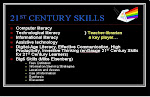
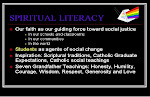
One of the predominant themes in my blog has been learning in the 21st century. Recently, I was involved in a meeting about how we can truly begin to prepare staff and students in our system for what this means in terms of access to technology, in particular, web-based technologies. When I watched this clip on YouTube, I thought that it speaks volumes about what is really at the heart of the conversation, and that's our kids. Have a look...
Showing posts with label inquiry-based learning. Show all posts
Showing posts with label inquiry-based learning. Show all posts
18 April 2010

11 December 2009
The 21st Century Learning Part 2
I'm a bit behind in my blogging - can ya tell?
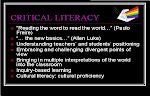
On December 3rd, we had the greatest time with teachers in part two of our series on The 21st Century Learner. Teachers got right into looking at the kinds of questions we as teachers ask of our students and how we can challenge our students more with deeper questioning. Next, we moved onto a really rich discussion in critical literacy. We examined what it is and what it isn't. We looked at some media texts and asked some really tough questions. Generally, I've found that critical literacy makes people really itchy but this group was really receptive to this world view. What made me a bit sad was that a teacher indicated that there is a negative stigma attached to embracing this kind of teaching. Teachers are really feeling pressured to conform to the ways things have always been done. My response was that teachers who believe in critical literacy often find themselves alone at first, but it catches on really quickly. Once colleagues see how engaged students are, they'll want to try it too.
In the lab, we "mucked around" with Delicious and I think teachers were excited about the "green potential" this application has.
All in all, a fantabulous day!
On December 3rd, we had the greatest time with teachers in part two of our series on The 21st Century Learner. Teachers got right into looking at the kinds of questions we as teachers ask of our students and how we can challenge our students more with deeper questioning. Next, we moved onto a really rich discussion in critical literacy. We examined what it is and what it isn't. We looked at some media texts and asked some really tough questions. Generally, I've found that critical literacy makes people really itchy but this group was really receptive to this world view. What made me a bit sad was that a teacher indicated that there is a negative stigma attached to embracing this kind of teaching. Teachers are really feeling pressured to conform to the ways things have always been done. My response was that teachers who believe in critical literacy often find themselves alone at first, but it catches on really quickly. Once colleagues see how engaged students are, they'll want to try it too.
In the lab, we "mucked around" with Delicious and I think teachers were excited about the "green potential" this application has.
All in all, a fantabulous day!
The 21st Century Learning Part 2
View more presentations from guest7a7987.
24 October 2009
Skill First, Content Second
This is me with another dear friend, Pat Chiarella (and that's Dave eating in background...). Pat teaches geography. Kids love her to pieces. She's one of the best teachers I know, but it has nothing to do with her popularity.

Without question, Pat knows her stuff. Any question of a geographic nature, she can handle it with information that is current and precise. I've had the fortune of being in her class a number of times while she's been teaching and it never ceases to amaze how ahead of the times she has always been.
I think, in all the research and reading that I have done on the subject, that if there is one thing I can emphasize as critical for 21st century teaching is the importance of teaching SKILL, not content. In this day and age, knowledge is no longer static, especially in disciplines like the social sciences. We need to impart our students with a skill set that will do them well in a multitude of subject areas so that they can deal with the ever-changing nature of knowledge and knowledge construction. That's why my friend Pat inspired this posting. At the centre of what she does is the skill - whether is mapping, graphing, note-taking or reading (yes, she is a geography teacher and she teaches reading in her subject area...), the content is never the star of the show. The beauty thing about this approach is that those kids are more likely to remember the skill more than the content when they take history the following year, and that's just fine because they'll be successful in their ability to learn the content through the invaluable skills they acquired the year before. I'm not saying that content no longer matters to 21st century learners, because it still does. Teachers are called to use their professional judgement, in conjunction with the Ministry documents to decide what content is truly essential to meet the overall expectations of a given course. In doing so, we stop teaching courses, and the focus turns to teaching students.
Maybe one day, this will be reflected in our curriculum documents. I mean, the newly revised Arts document is on its way to being THE quintessential 21st century document. The strands were re-named and re-ordered and Creating and Presentation is now the first strand in all of the areas of Arts. It's a small but significant change. It places the construction of demonstration of new knowledge literally at the forefront of every course of study, which means that the acquisition of a specific skill set is crucial. If this was done in every discipline, Ontario would be on its way to catching up with the times, and Pat's geography class. For now, I can be content with this being done one document at a time.

Without question, Pat knows her stuff. Any question of a geographic nature, she can handle it with information that is current and precise. I've had the fortune of being in her class a number of times while she's been teaching and it never ceases to amaze how ahead of the times she has always been.
I think, in all the research and reading that I have done on the subject, that if there is one thing I can emphasize as critical for 21st century teaching is the importance of teaching SKILL, not content. In this day and age, knowledge is no longer static, especially in disciplines like the social sciences. We need to impart our students with a skill set that will do them well in a multitude of subject areas so that they can deal with the ever-changing nature of knowledge and knowledge construction. That's why my friend Pat inspired this posting. At the centre of what she does is the skill - whether is mapping, graphing, note-taking or reading (yes, she is a geography teacher and she teaches reading in her subject area...), the content is never the star of the show. The beauty thing about this approach is that those kids are more likely to remember the skill more than the content when they take history the following year, and that's just fine because they'll be successful in their ability to learn the content through the invaluable skills they acquired the year before. I'm not saying that content no longer matters to 21st century learners, because it still does. Teachers are called to use their professional judgement, in conjunction with the Ministry documents to decide what content is truly essential to meet the overall expectations of a given course. In doing so, we stop teaching courses, and the focus turns to teaching students.
Maybe one day, this will be reflected in our curriculum documents. I mean, the newly revised Arts document is on its way to being THE quintessential 21st century document. The strands were re-named and re-ordered and Creating and Presentation is now the first strand in all of the areas of Arts. It's a small but significant change. It places the construction of demonstration of new knowledge literally at the forefront of every course of study, which means that the acquisition of a specific skill set is crucial. If this was done in every discipline, Ontario would be on its way to catching up with the times, and Pat's geography class. For now, I can be content with this being done one document at a time.
14 September 2009
I forgot about Alvin...

Alvin Toffler is a futurist. He and his wife Heidi are prolific authors and are "known for having forecast the acceleration of daily life, the decline of the nuclear family, the spread of loneliness and rise of religion, the Tofflers decades ago also anticipated cloning, virtual reality, niche markets, information overload, work-at-home, product customization, the "de-massification" of the mass media, the threat of terrorism and many other features of contemporary life." (www.alvintoffler.net) Educators know him more commonly by his famous quote:
"The illiterate of the 21st century will not be those who cannot read and write, but those who cannot learn, unlearn, and relearn."It's this quote that has me excited about the Professional Learning Series that we're running this year for teachers. There are three series - Critical Literacy, Cross-Curricular Literacy and 21st Century Skills. What's different about what my partner and I are doing this year is that we're including a job-embedded professional learning component for each teacher who participates in any of the series. I have to admit that I was unimpressed by the idea at first. Truthfully, my cynicism was the result of reservations I had about teachers' levels of receptivity to the idea of co-planning, co-teaching and co-debriefing. Generally speaking, I'm not one to care much what people think, especially when it comes to projects that only to improving student learning. That said, if no one buys in then practice when never shift - that includes my own. I was initially resistant to the idea of "coaching" other teachers. After all what could I possibly offer a science, technology, or french teacher. I have come to a better understanding that it really isn't about WHAT is being taught. It's about practice and that's a universal language in teaching. Ultimately, the goals of this process are basically four-fold:
1.) to increase student achievement;
2.) to improve student learning;
3.) to refine existing instructional strategies; and
4.) to introduce new strategies withing a supportive framework.

To me, this sounds pretty good. It embraces the spirit of Toffler in that teachers are called to be truly reflective and REFLEXIVE in their practice, essentially, engaging the process of learning, unlearning and relearning. This is the very essence of critical pedagogy.I can certainly understand why teachers may not be rushing to book time to work with me. It can be pretty intimidating having another educator, much less central staff, working with you in your classroom. It is invasive. From time to time, I think it's a good thing. For me, I suffer from the "three year itch", where I get a bit bored and I look to be challenged in my profession. I can't imagine anything that would make teachers more itchy than this. It's completely voluntary, so there is no telling how many will take me up on the offer.
Engaging in this process with my colleagues will by very uncomfortable and intimidating for me, so I can only imagine how other teachers will feel. It's one thing to sit around the table and brainstorm solid instructional straegies, but moving into a teacher's "turf" is a different story.
Very itchy...
12 June 2009
inquiry based learning with Web2.0
Check out this SlideShare Presentation:
inquiry based learning with Web2.0
View more Microsoft Word documents from paulreid.
16 May 2009
Current Events is NOT a Thing of the Past...
Once upon a time, teachers used to compel students to bring in newspaper clippings and we'd all take turns summarizing the story. Some teachers kept bulletin boards of those clippings and others asked their students to keep journals or scrapbooks. There was always some sort of learning attached to this literacy event - summary writing, learning to recount or retell, or even simply writing a news report ourselves. I worry that students don't talk about what's going on in the world around them. I wonder if our kids could make sense of these editorial cartoons:


Why rely so heavily on textbooks when the world itself is providing the content that we can use to teach our students necessary and relevant skills to live in it?
I'm not suggesting returning to the age-old practice of cutting and pasting. This is neither relevant to our students nor effective for our teaching. All I'm saying is that the news should play an active role in our programming and course work so that real-life connections can be made on a regular basis. Admittedly, I'm pretty disturbed that some teachers are STILL asking kids to cut and paste articles, summarize them and expect students to understand that they have just acquired some pretty important skills. Let's keep it real...

(Could our students understand the humour behind this cartoon? Can they articulate why this is relevant to them?)

(Do our kids really understand what's going on? Do they understand the meaning of words like "pandemic"? Do they possess the necessary health literacy to navigate the health care system?)

(When hasn't this issue been in the news? Do our students understand the implications of what the Pope is saying? What it means to the historical context of this story?)
Why rely so heavily on textbooks when the world itself is providing the content that we can use to teach our students necessary and relevant skills to live in it?
I'm not suggesting returning to the age-old practice of cutting and pasting. This is neither relevant to our students nor effective for our teaching. All I'm saying is that the news should play an active role in our programming and course work so that real-life connections can be made on a regular basis. Admittedly, I'm pretty disturbed that some teachers are STILL asking kids to cut and paste articles, summarize them and expect students to understand that they have just acquired some pretty important skills. Let's keep it real...
04 May 2009
The Good Path... More Inclusivity in our Schools

I was so fortunate to have been given the opportunity to attend an Aboriginal Education symposium at the Nottawasaga Inn called "The Good Path: Sharing the Journey". It is always a good thing when given the chance to dialogue with colleagues from other boards to see what's happening throughout the province among the 11 Barrie District school boards. Members of the Aboriginal community were in attendance as well.
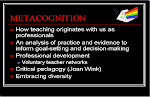
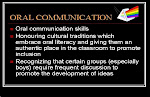
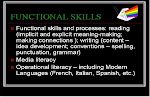
We arrived on the evening of April 29 and were treated to a very moving keynote addressed delivered by Shelley Knott-Fife, Educational Officer from the Aboriginal Education Office of the Ministry of Education. I had heard the same address a couple weeks ago and yet the experience was different. Maybe it had something to do with the mood of the room. Let's face it, when the audience has already bought into the message, the enthusiasm is unmistakable. One of the points that Shelley made that really touched a nerve with me made reference to the point that for those people who belong to ethinic cultures that are not native to Canada can seek that culture out and in a specific place in the world find the very essence of what that culture is (i.e. Italians can seek their culture in Italy, Cubans in Cuba, Jamaicas in Jamaica, etc.). For First Nations, Canada is IT. It's the only home they have and have ever known. Holy smokes! The implications for education are ginormous. Would a student of Aboriginal ancestry feel "at home" in what they are learning? Does he or she see any sort of familiarity in the curriculum? I always found it so amazing that we invest so much time, energy and resources in promoting multiculturalism and yet we've done a dismal job at celebrating the FIRST cultural group. In education, or society in general, these conditions lend themselves to what I call the "flavour of the month" syndrome that we happily buy into because they appear to be solutions to the bigger problem. Take Black History Month for example... Is February the ONLY time it's important? Is black history not Canadian history? Of course it is! We have a civic obligation to know it. Aboriginal history IS Canadian history and it should be a natural, seemless part of what we do. I really think that the work being done with the Literacy Prism is going to begin to help with this.
We were also treated to a concert (and a stand-up routine of sorts) by Tom Jackson. I didn't realize how tall he was but it was great to be in the presence of such an accomplished Canadian. An interesting voice... Willy Nelson -ish...
My favourite part of the conference came the following morning on April 30 during the opening prayer and drum ceremony. A young man played his drum and sang. I have never seen so much understated passion and conviction in a person of his age in all my years of teaching. It was beautiful and I can't remember the last time I was moved by something as profounding as I was that morning.
The rest of the day was spent in workshop sessions and I learned quite a lot. I learned that this process isn't going to be easy, but it has to be done. Our Aboriginal kids and their families deserve to reclaim the voice that has been systemically silenced for too long. Educators have to take a long hard look at what they are teaching and how they are doing and honestly assessing if any of it is causing harm to any of their students. I am so looking forward to the journey our board is on to honour our students of Aboriginal ancestry. (By the way, the super-terrific graphic was a logo designed for our board by Todd Jamieson and Alfie Fishgap. We love it!)
22 April 2009
Critical Literacy and Religion: An Androgynous Jesus?

How's this for an interesting lesson in critical literacy for religion teachers! I have never seen Christ rendered in any art form quite like this. The following excerpt comes from a website that deals with Christ iconography:This image "Jesus of the People" by Janet McKenzie portrays Jesus as relatively androgynous and as black. Edwina Sandys' Christa portrays Jesus as a woman hanging on the cross, and was extremely controversial. Reinterpretations like these make the symbol of Jesus Christ accesible to people who do not wish to accept the traditional white European male image. Many feminists have chosen to reinterpret Christ, not visually but theoretically, and this is often labeled feminist christology.<(http://www2.kenyon.edu/Depts/Religion/Projects/Reln91/Gender/qchristology.htm)
This exercise is a great opportunity to look at conventional portrayals of Jesus and discuss why they were chosen or deemed acceptable? By whom? For what purpose? Are there any underlying issues of power that are implicated in certain portrayals of Christ? Why are most renderings of Christ reflect a man of northern European descent as opposed to Middle Eastern ancestry?
I would LOVE to hear what students have to say on this. I think this sort of activity is guaranteed to promote high levels of engagement because:
1.) it's inquiry based learning
2.)it involves a great deal of inductive reasoning (your boys will thank you)
3.)it's highly controversial - what teenager doesn't like to challenge the status
quo?
4.)students are doing all the meaning-making, while participating in highly academic
processes(research, synthesis, evaluation, etc.)
In the past, I have challenged my students to create their own artistic renderings of Jesus and the diversity is astounding. Their creations often reflect their own personal relationship with Jesus. I have often taught this sort of lesson in the context of discussing how the four gospels provide very distinct representations of who Jesus is (supported by an article called "The Four Faces of Jesus"). I have done this lesson with grade 10 students taking the Christ in Culture course. A sure winner!
Subscribe to:
Posts (Atom)